
One of the most entertaining ideas I’ve learned in graduate school has been the idea of the rabbit hole. This term stems from Lewis Carroll’s “Alice’s Adventures in Wonderland,” where Alice takes a trip into a rabbit hole and encounters all of the surreal fantastical experiences of the novel. In a scientific context the “rabbit hole” has come to describe the intellectual process of taking a deep dive into some concept or field of knowledge. The scientific process is full of these sorts of trips. Very often in the lab some hint of a connection between phenomena comes up and I find myself several hours later with 50 new journal articles to read, a head full of questions, deep in a rabbit hole trying to find a subterranean path to my own work. Diving down the rabbit hole has come to encompass any headlong, curiosity driven information binge.
I recently had a severe burn on my hand and in an effort to understand why my skin appeared to be melting off, I dove straight into the wonderland of phytophotodermatitis. This post is a departure from the style usually featured here. I’ll be covering a scientific adventure for a change.
To understand phytophotodermatitis it’s helpful to understand how a regular sunburn works, because the two are related. The DNA in all of the cells in your body is made up building blocks called nucleotides. A nucleotide has three components, including a nitrogenous base bound to a sugar molecule which is in turn bound to a phosphate. There are four types of nitrogenous bases: cytosine, adenine, guanine and thymine. The ribose sugar and the phosphate allow nucleotides to be bound to each other forming a string. Each nitrogenous base on a strand of DNA is able to form bonds with a partner base: adenine with thymine, cytosine with guanine. This base-pairing is called “complementarity” and is the reason with have two strands of DNA contained in each chromosome. Together these four bases comprise a quaternary code that contains all of the information that makes a human being, or any animal on earth for that matter. DNA has many interesting properties, but one of the most unfortunate is that it can absorb UV radiation.
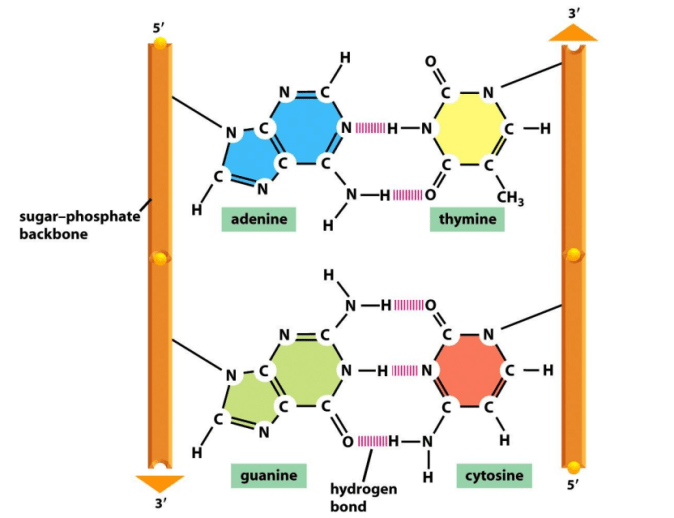
UV stands for ultraviolet radiation and is similar to the radiation that makes up visible light, but it is a type that we don’t have any photo-receptors for and so our eyes can’t see it. It is also much more energetic, meaning each photon of UV light carries more energy than one of the longer wavelength we can actually see. Because of the chemical quirks of DNA, it can absorb some of this UV radiation. When any molecule absorbs radiation it can become “excited” and this is not a good type of excited in the case of DNA. When DNA is in an excited state, the electrons in the molecule are agitated – kinda like they’ve had way too much coffee and they’re too high energy. They need a way to release this energy and there are a few ways they can do it. Sometimes they can release the energy as heat, which is generally harmless. Sometimes they release it as light (which is why DNA glows under a UV light). Other times they release it by channeling the energy into the formation of new bonds. This is very bad for DNA because all of the biology of the cell depends on DNA being structurally sound. Forming new bonds between the bases disrupts all of the processes that your cells need to survive. One of the most famous of these UV induced bonds is called the thymine-thymine dimer, where an excited thymine forms a new pair of bonds with the thymine adjacent to it on the DNA strand, rather than with the adenine on the complimentary strand:

These thymine dimers are a type of mutation in the DNA that can prevent your cells from accessing the information they need in the DNA strands, effectively breaking it. Luckily nature has come up with DNA repair mechanisms that fix this damage. However, when you experience too much DNA damage from UV radiation, the amount of damage exceeds the ability for the cell to repair. Your cells are pretty smart and when they sense this state of irreparable DNA, they throw in the towel in a process call apoptosis – programmed cell death. This is the basis for how sunburns work. UV radiation causes damage to your DNA that is too much for them to handle, and an entire layer of your skin calls it quits and dies. The redness is inflammation from your body trying to handle the stress of all these dying cells and the sloughing and peeling is the new layer of skin pushing out the old skeletons.
UV radiation is clearly very bad for skin cells. This is why sunscreen companies advertise the UV blocking ability of their products. The chemicals in the sunscreen absorb the UV radiation, taking the burden off of your DNA. The ability for UV radiation to cause damage to your DNA is also the reason excess exposure to UV radiation results in skin cancer. Some of the time your cells think they’ve repaired all the damage from the exposure, but a few mutations sneak through into the next cell division. If you happen to get a mutation in a gene that tells your cells to grow and never stop then your risk of cancer goes way up. Use that sunscreen! It might save your life.
So what is phytophotodermatitis? It’s basically a big word to describe a skin reaction (-dermatitis) caused by plant material (phyto-) that is activated by light (-photo-). Lets start with the phyto: Certain plants have developed a very clever way to protect themselves in the form of chemicals called furocoumarins. These compounds are produced by several different plants including parsley, celery, carrots, limes and hogweeds (for a complete list check out the wikipedia page).
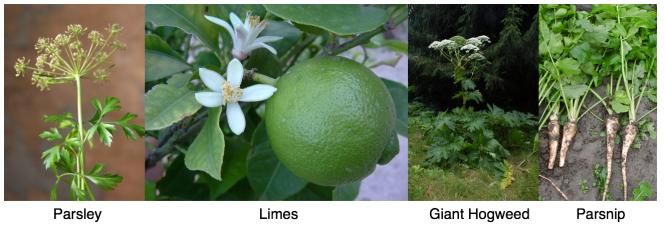
Furocoumarins produced by these plants come in a variety of shapes and sizes, but they generally have a structure similar to the following:
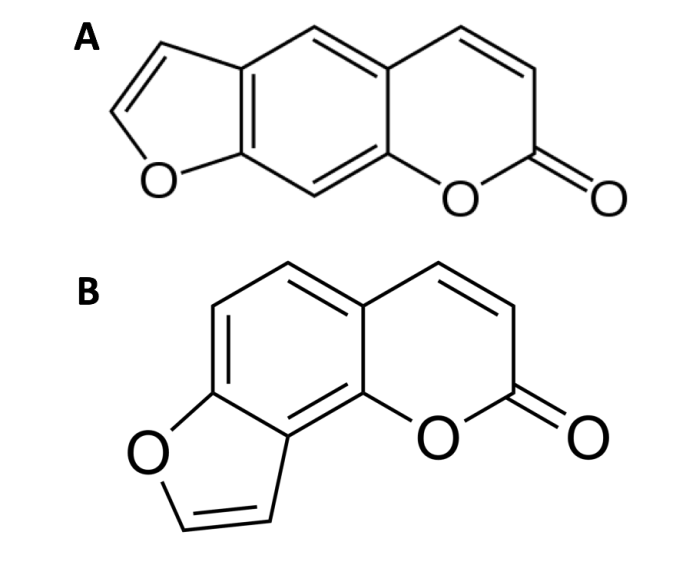
So what do these furocoumarins do? They get EXCITED! In a really bad way. Think about what I mentioned earlier about DNA having a bit too much coffee and having too much energy, but replace coffee with meth. These compounds are the molecular equivalent of a meth addict on a rampage. Like those episodes of Cops where some crazy naked dude is running around half invincible in a drug addled frenzy and it takes a whole squad car to wrestle them down. I digress. Here’s how they mess you up:
You’re minding your own business, making margaritas (or in my case eating some delicious tacos) and you splash some lime juice on your hands. No biggie, it’s just the best citrus and you leave it on because (you forgot to wash your hands) you like the idea of being closer to nature. In that lime juice are these little meth heads and because of their chemical structure they’re basically a bunch of little greased pigs and can slip right into your cells. They’re harmless in this state and your cells start trying to clean them up. BUT if you happen to not be wearing sunblock and experiencing direct sunshine, these little greased pigs get a huge hit of UV radiation. They absorb this radiation easily and hold it in an excited state, poised to release it like a junkie in a blind rage. They start forming bonds all over the place, but the one’s that do the most damage are when they bond to your DNA directly. This is called “alkylation” and it’s when any substance forms a permanent chemical bond to your DNA. Furocoumarins are exceptionally good at this and they really mess up your DNA. The process is similar to the DNA damage caused by a sunburn, but the damage is much more severe and the cleanup is much more difficult for your cell. It essentially causes a super-sunburn. The damage can be caused extremely quickly too, on the order minutes of sun exposure. It doesn’t take a lot to photo-activate these compounds.
The key here though is that these chemicals need UV radiation in order to get their molecular meth. They’re not excited by much else. So if you’re making margaritas in the dark, or wearing sun-screen you’re much more – but not entirely – protected. Your skin also provides a pretty solid barrier against them, but only for so long. If you wash off the lime juice before it has time to penetrate your skin you can also do a lot to protect yourself. The danger appears when the furocoumarins are on your skin long enough to slip into the interior of the cell, and then you get exposed to UV radiation. This combo has some serious effects.
What follows are some images of phytophotodermatitis. They are graphic. And also rad if you’re medically interested.
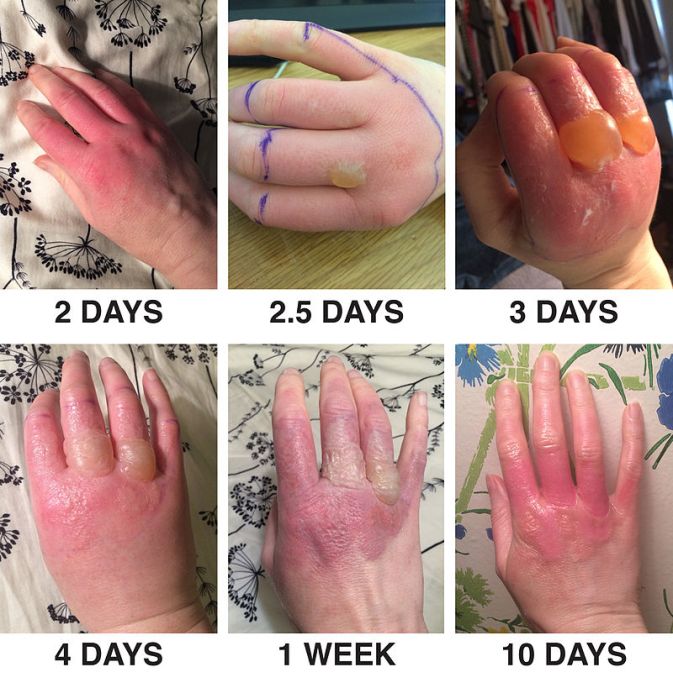

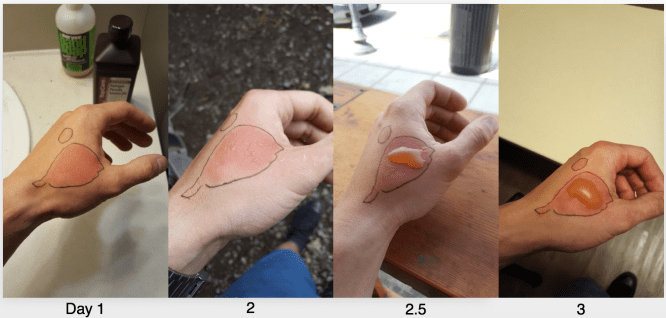
An Imgur gallery for your viewing pleasure: https://imgur.com/gallery/TyE5i
The biggest bummer about phytophotodermatitis is that the burns can cause permanent scarring. These scars can be pretty dark and unsightly, but hey chicks dig scars right? I’m curious to see how mine turns out but if you’re not into that biz then cover up and use sunscreen while things heal. Sun exposure makes the scar darken.
The takeaway: be careful with these plants. Make sure to clean up after you come into contact with them and if you can’t avoid them, make sure to use lots of sunscreen and limit exposure to the sun. Bad sunburns like this massively increase your chances of getting skin cancer [2].
Bibliography:
https://en.wikipedia.org/wiki/Phytophotodermatitis
https://en.wikipedia.org/wiki/Furanocoumarin
https://en.wikipedia.org/wiki/Heracleum_mantegazzianum
https://en.wikipedia.org/wiki/Lime_(fruit)
https://en.wikipedia.org/wiki/Parsley
https://en.wikipedia.org/wiki/Parsnip
http://catskillinvasives.com/index.php/terrestrial-plants/giant-hogweed/
- Phytophotodermatitis: Background, Pathophysiology, Epidemiology. Available at: https://emedicine.medscape.com/article/1119566-overview. (Accessed: 24th June 2018)
- Wu, S. et al. History of Severe Sunburn and Risk of Skin Cancer Among Women and Men in 2 Prospective Cohort Studies. Am. J. Epidemiol. 183, 824–833 (2016).
- Alberts, B., Wilson, J. & Hunt, T. Molecular biology of the cell. (Garland Science, 2008).
 Andrew Bondesson
